Bespoke vs. Made to Measure Suits in Vancouver: What’s the Real Difference?
The short answer: a made-to-measure suit starts from a manufacturer’s existing pattern, adjusted to your measurements within set limits, and arrives finished. A bespoke suit starts from a pattern drafted by hand from scratch just for you, is built through a basted fitting, and is shaped and finished largely by hand.
“Bespoke” is one of the most misused words in menswear. Men regularly come into our shop telling us their suits are bespoke. When we dig into how the garment was actually produced, it turns out they were sold a made-to-measure suit dressed up as bespoke.
It’s one of the questions we hear most often, so we wrote this post. Below are the key details that make a bespoke suit truly bespoke, and how to tell the difference between the two.
Where Does the Word “Bespoke” Come From?
The word bespoke comes from the old English verb “bespeak,” meaning to speak for or order something in advance. In 17th and 18th century London tailoring shops, bolts of cloth sat on display. When a customer chose a cloth, it was “bespoken”: spoken for, and reserved for that one person.
The suit was then cut from scratch, from a pattern drafted individually for him. That’s where the term got its meaning: made for one specific customer, starting from nothing.
Today, the word gets thrown around loosely across the menswear industry, often to sell custom or made-to-measure garments.
How the Pattern Separates Bespoke From Made to Measure
The biggest difference between bespoke and made to measure is the pattern. It’s the blueprint every piece of your suit is cut from, and where it starts determines how far it can go.
Made to measure starts from a base pattern. A made-to-measure garment begins with a set pattern from the manufacturer. During your appointment, you try on a sample garment in your size, in the manufacturer’s model that best suits your body type.
Your tailor then studies how it fits and records adjustments to correct whatever isn’t right for you. That might mean adding or taking away at the chest, waist or seat, adjusting sleeve and jacket length, or making posture adjustments for sloping shoulders, a forward stance or a fuller seat. Those changes modify the base pattern slightly to suit your body. But there are boundaries.
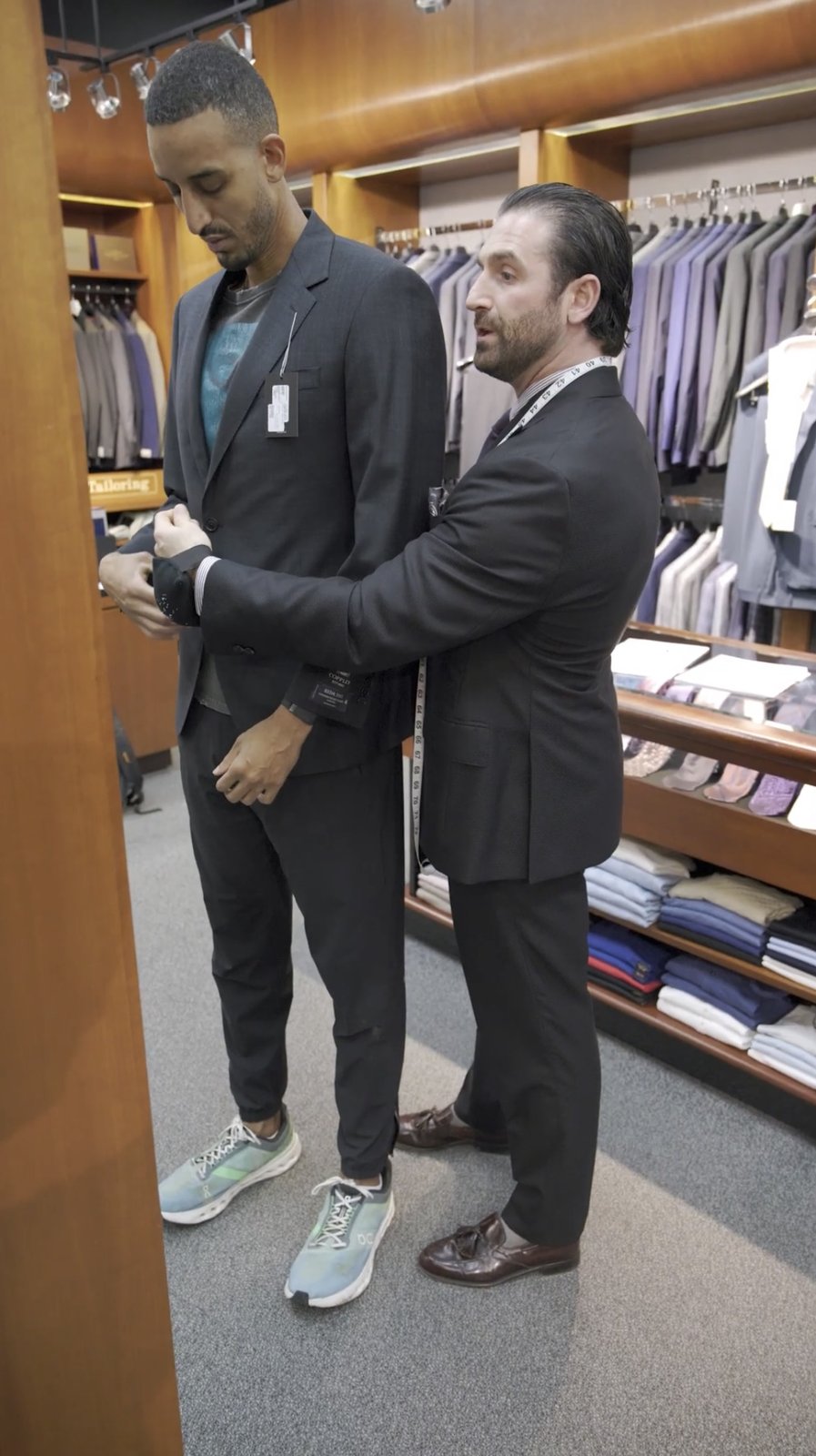
Why made to measure has limits. Most made-to-measure garments are cut by computerized cutting systems, commonly called Gerber machines after the company that pioneered them. These large automated cutters work from base patterns, and the software can only move so far from the original.
That’s because every line on a pattern is connected. Enter an extreme measurement for a very unique build, and the software has to stretch that one line past its logical limit. That single change pulls on the neckline, warps the shoulder angle and breaks the geometry of the rest of the suit.
To prevent this, manufacturers program hard limits into the software. It’s a digital guardrail that says: you can adjust this waist by 2 or 3 inches, but if you try 8, the jacket will distort, so the system won’t allow it.
A real example from our shop. A bodybuilder came to us needing a sport coat for a wedding. He had a 49-inch chest and a 34-inch waist, a 15-inch “drop” from chest to waist. For reference, off-the-rack jackets are typically built on a 6-inch drop. (It’s a common challenge we cover in our guide to the best suits for athletic builds in Vancouver.)
In made to measure, the manufacturer’s limits only let us take an extra 6 inches out of the standard drop, for a maximum 12-inch drop. That left us 3 inches short, so we would have had to take the waist in another 3 inches once the coat arrived.
We decided against it. Taking that much out after the fact would throw off the proportions: the pockets would sit out of alignment and the front would distort. We couldn’t guarantee the result, so the right answer was bespoke, with a basted fitting to get it right.
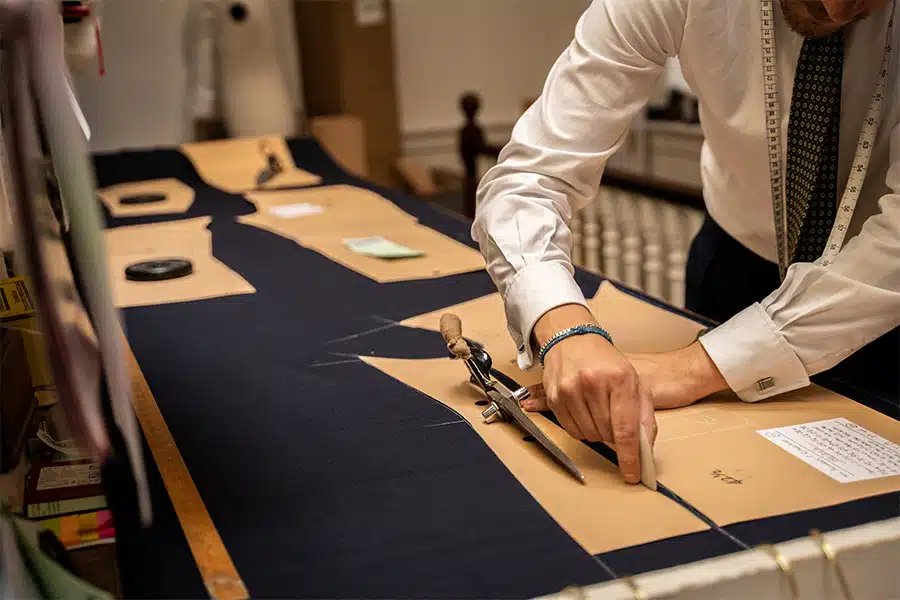
Bespoke starts from a blank page. A true bespoke suit has a pattern drafted specifically for you. It’s drawn and cut by hand by a tailor or pattern maker, usually with years of experience in the craft.
Instead of twisting a pre-made shape until the math breaks, they start with a blank sheet of paper and draft a new blueprint built only for you. A dramatic drop, one shoulder lower than the other, or a very upright posture is built into the pattern from the start, not forced in afterward.
Your pattern is also kept on file. Every future suit starts from a pattern already proven on your body, and it can be refined as your shape changes.
Why the Basted Fitting Is the Biggest Tell
This is one of the biggest tells, if not the biggest, of whether you’re getting made to measure or bespoke: a basted fitting, and often more than one fitting.
Made to measure arrives finished. You choose your fabric, and measurements are taken from your body, from a try-on garment, or a combination of both. The production house then cuts and sews the garment, which usually takes around 4 to 6 weeks.
When it arrives, it’s finished. All the proportions have been worked out from your measurements and the limits the pattern allows. Any final tweaks are done as in-store alterations on a completed suit.
Bespoke is built through fittings. Measurements are taken from the body, often with a fitter’s help, and a pattern is drafted for you. The garment is cut from that pattern and loosely hand-stitched together, or “basted,” usually in a throwaway cloth.
At the basted fitting, the tailor pins and chalks the garment on your body, marking every change needed for a better fit. The basted garment is then taken apart and each piece is corrected to those markings. The corrected pieces are laid on the cloth you chose, cut, sewn together and finished.
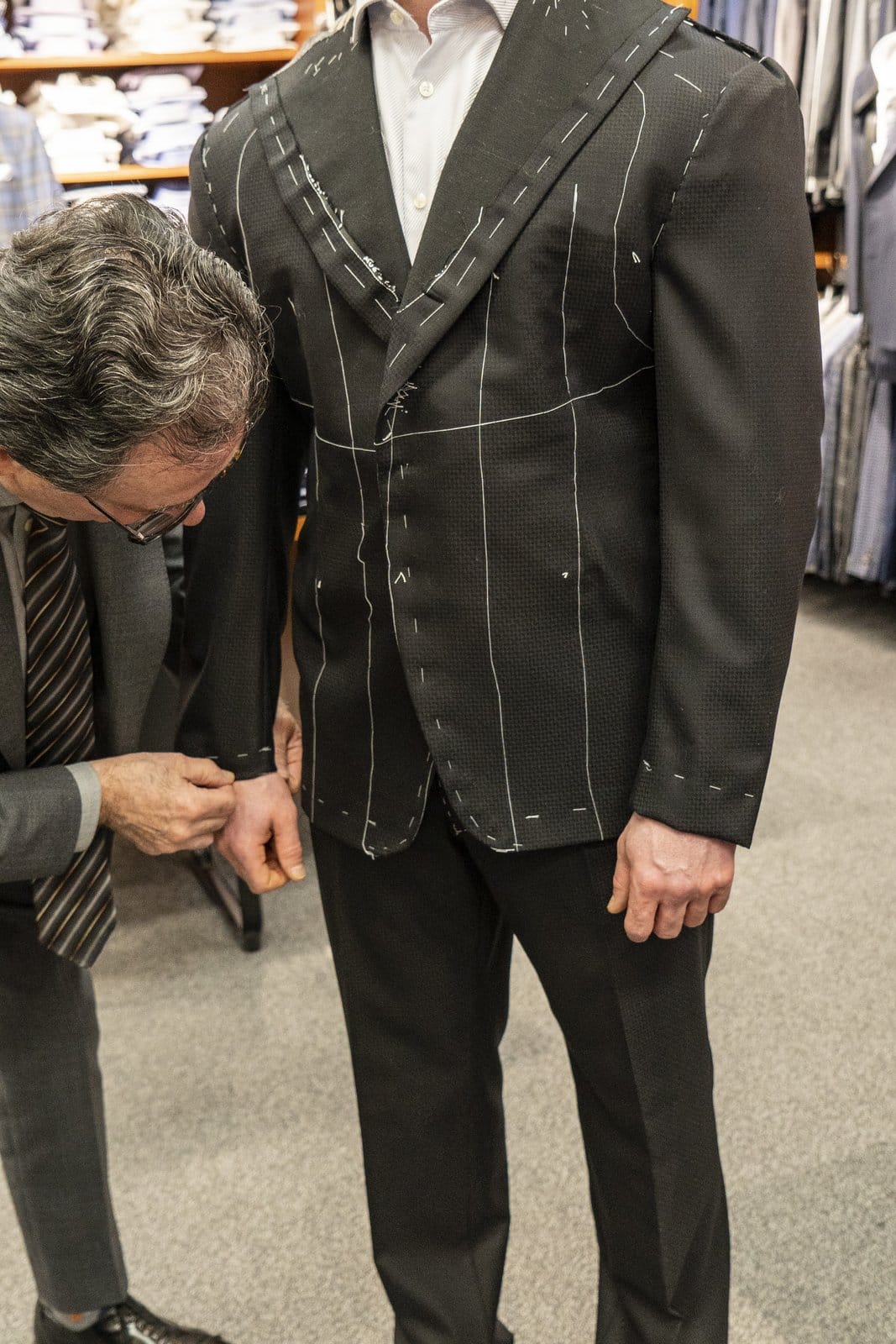
In most cases, one basted fitting is enough, but a second may be needed in certain circumstances.
Because pockets and buttonholes are typically added after the basted fitting, they can be placed exactly where they belong on your body. Made to measure doesn’t offer this, since pocket and buttonhole positions are set before the garment is cut.
How Construction Differs Between Bespoke and Made to Measure
Construction differences are harder to spot, because so much comes down to fine handwork and craftsmanship. Remember these details: they’re how you tell whether a garment is closer to bespoke or made to measure.
Canvas. The canvas is the internal structure that gives a jacket its shape through the chest and lapels.
- Made to measure: Usually fused (glued) or half canvas. Full canvas is available in some models, typically at a higher price, but it’s pad-stitched by machine.
- Bespoke: A full floating canvas built from layers such as horsehair and haircloth, with the chest piece and lapels pad-stitched by hand. This lets the garment move freely with your body and mould to you over time.
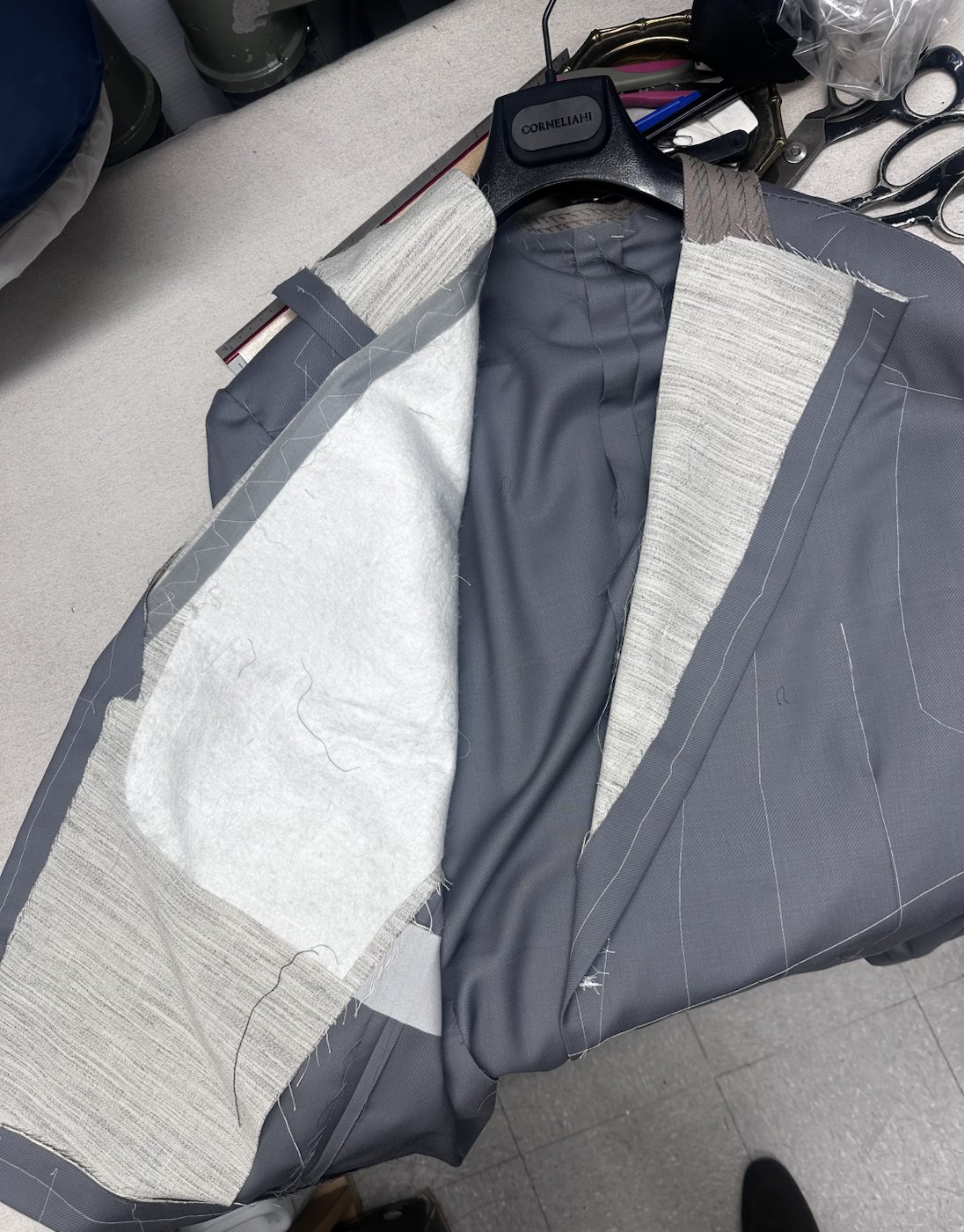
Shaping.
- Made to measure: Shape comes mostly from seams, darts and fusing.
- Bespoke: Heavy ironwork. Using heat, moisture and pressure, the tailor shrinks and stretches the wool before and during construction. A flat piece of cloth becomes a three-dimensional form that follows the chest, shoulder blades and seat.
Sleeves.
- Made to measure: Set by machine.
- Bespoke: Set and pitched by hand at the fitting, with the shoulder shaped to the client. A hand-set sleeve allows greater freedom of movement in the sleeve head than one sewn by machine.
Collar.
- Made to measure: Attached by machine, with a fused undercollar.
- Bespoke: A hand-padded felt undercollar, with the collar felled by hand.
Hand work.
- Made to measure: Very minimal. Buttonholes are sewn by a buttonhole machine, and the centre is cut open after stitching. Better machines cut first and sew after, which makes a cleaner buttonhole. Details like pick stitching are also done by machine.
- Bespoke: Nearly every stage that shapes or finishes the coat is sewn by hand: pad-stitching the canvas and lapels, basting for fittings, setting the sleeves, and felling the collar and lining. Hand stitches are softer and more flexible than machine seams, so the garment moves with the body and keeps its shape. They can also be unpicked for future alterations.
Hand-sewn buttonholes, pick stitching and bar tacks are the visible finishing marks of that work. Look closely at these details. This is where you can really distinguish a bespoke garment from made to measure.
Inlays. Inlays are the extra seam allowance left inside a garment so it can be let out later.
- Made to measure: Smaller seam allowances. Better manufacturers leave a decent amount where men most often need to be let out: the jacket waist, trouser waist, trouser seat and length.
- Bespoke: More generous, with extra cloth left in all the important areas so the garment can be worn for decades, as long as you don’t change size entirely.
Lead time.
- Made to measure: About 4 to 6 weeks for the finished garment to land in store, before any in-store alterations.
- Bespoke: In our experience, typically 6 to 12 weeks, depending on the maker. Much of that depends on how quickly the client completes the basted fitting or fittings, and the time to ship the garment back and forth to the maker.
Bespoke vs. made to measure at a glance:
| Made to Measure | Bespoke | |
|---|---|---|
| Pattern | Manufacturer’s base pattern, adjusted within limits | Drafted by hand from scratch for you |
| Fittings | Delivered finished | Basted fitting, sometimes two |
| Canvas | Fused or half canvas; full canvas machine pad-stitched | Full floating canvas, hand pad-stitched |
| Shaping | Seams, darts and fusing | Ironwork: heat, moisture and pressure |
| Sleeves | Machine-set | Hand-set and pitched at the fitting |
| Collar | Machine-attached, fused undercollar | Hand-padded felt undercollar, hand-felled |
| Hand work | Minimal | Nearly every stage |
| Inlays | Smaller, in key areas | Generous throughout |
| Cloth | The manufacturer’s fabric books | Almost any mill |
| Design | A set menu of options | Nearly any detail you want |
| Lead time | 4–6 weeks | 6–12 weeks |
Why Bespoke Gives You More Freedom in Cloth and Design
Fit isn’t the only reason men choose bespoke. With made to measure, you choose from the manufacturer’s fabric books and a set menu of style options, such as fixed lapel widths and pocket styles.
With bespoke, there’s no base pattern to work within. Your tailor can usually source cloth from almost any mill, and nearly any design detail is possible, from the exact width of your lapel to the shape of your pockets.
How Much Does a Bespoke Suit Cost Compared to Made to Measure?
Price is one of the quickest ways to tell whether a company is passing off made to measure as bespoke. All prices below are in Canadian dollars, as of 2026.
Made-to-measure pricing comes down to two things: the fabric, and where and how the garment is made.
Fabric is one of the biggest factors. Is it 100% wool, or is there polyester in it? Is it Super 100s or Super 150s wool? Cashmere? A blend of wool, silk and linen? Where the cloth is woven matters too, and most high-quality fabrics come from Italy.
Next is construction: where the garment is made and how. Labour costs differ widely between, say, Asia and Italy.
- Made in Asia (even with Italian cloth): $700 to $1,200, depending on quality and make.
- Made in North America or Canada: $1,500 to $2,500. Labour costs are higher, and these makers typically use mid- to high-end fabrics with more thorough construction than their Asian counterparts.
- Made in Italy: $1,700 to around $4,000, depending on the fabric. Quality of construction varies, but the craftsmanship is there: Italy has some of the best garment makers in the world.
Bespoke pricing. With bespoke, you’ll almost always be offered some of the best fabrics from the best mills in the world, and they come at a higher price point. It would be rare for an established tailor to offer lesser fabric in a bespoke make. The two just don’t go together.
Then there’s the time and labour: the handwork, the full canvas, the fittings and the detail in construction. Expect a bespoke two-piece suit to cost $5,000 to $15,000 or more. Everyday fabrics such as Super 120s wool typically land around $5,000 to $8,000. At the top of the range, most of the price comes from the fabric chosen.
What Do “Semi-Bespoke” and “Su Misura” Really Mean?
This is where most of the confusion lives. Between true bespoke and standard made to measure sits a grey zone of terms: semi-bespoke, su misura, hand-tailored or simply “custom.”
These usually describe made to measure with some extra touches, such as hand finishing, a full canvas or a fitting in a sample garment. Those upgrades can make for a very good suit. But if the pattern still starts from the manufacturer’s base and there’s no basted fitting, it’s still made to measure.
How to Tell If Your Suit Is Really Bespoke
Before you buy, ask:
- Is a pattern being drafted from scratch just for me, and will it be kept on file?
- Will I have a basted fitting?
- Is the jacket full floating canvas, pad-stitched by hand?
- Are the buttonholes sewn by hand?
- Does the price reflect the handwork and the cloth?
If the answer to most of these is no, it’s made to measure, however it’s being marketed.
Who Should Choose a Bespoke Suit?
If you have a fairly typical build, close to most manufacturers’ specifications in your size, you don’t need bespoke to get the fit right. If fit is your only concern, made to measure is probably the better choice from a cost perspective. Not sure what size you really are? Start with why most men buy the wrong suit size.
If your proportions are irregular enough that made to measure won’t cut it, bespoke is your option. And if you want to go all in on a perfect fit, bespoke is the standard.
How to Choose Between Bespoke and Made to Measure
Many factors go into choosing between made to measure and bespoke. Start with these questions:
- What’s your budget? This is usually the biggest deciding factor, so set it first.
- What matters most to you? Is it the quality of construction, the fabric selection, or both?
- What is the suit for? Is it your wedding, and you want the very best? Or a workhorse for the office?
- How often will you wear it, and for how long? Do you want a suit that lasts for decades?
What is the difference between bespoke and made to measure?
Made to measure adjusts a manufacturer’s existing pattern to your measurements, within set limits, and arrives as a finished garment. Bespoke uses a pattern drafted by hand from scratch for you, built through a basted fitting, with far more handwork in the construction.
Where can I get a bespoke suit in Vancouver?
Brascia’s Tailors at 580 Hornby Street in downtown Vancouver offers both bespoke and made-to-measure suits, and has been dressing Vancouver since 1977.
How much does a bespoke suit cost?
As of 2026, a bespoke two-piece suit typically costs $5,000 to $15,000 CAD or more. Suits in everyday fabrics such as Super 120s wool usually fall around $5,000 to $8,000.
How long does it take to make a bespoke suit?
Typically 6 to 12 weeks, depending on the maker, how quickly you complete your fittings, and shipping time between the shop and the maker. Made to measure usually takes 4 to 6 weeks.
What is a basted fitting?
A basted fitting is a fitting in a loosely hand-stitched version of your suit, usually in a throwaway cloth. The tailor pins and chalks it on your body, then corrects the pattern before your chosen fabric is cut.
Is a made-to-measure suit worth it?
For most men with a fairly typical build, yes. Made to measure gives a much better fit and more personalization than off the rack, at a lower cost than bespoke.
How can I tell if a suit is really bespoke?
Ask whether the pattern is drafted from scratch for you, whether there is a basted fitting, and whether the canvas and buttonholes are done by hand. If the price is in made-to-measure territory, it almost certainly isn’t bespoke.
Final Thoughts on Bespoke vs. Made to Measure in Vancouver
In our opinion, there’s nothing wrong with choosing made to measure over bespoke. It’s like shopping for a car. A Honda or a Toyota will get you where you’re going. A BMW or a Mercedes is a step up. And some men won’t settle for anything but a Ferrari. They’re all cars, and they’ll all do the job. But they aren’t the same car, and no one should sell you a Toyota with a Ferrari badge on it.
That’s the real problem with “bespoke” today. The difference comes down to three things you can check: a pattern drafted from scratch for you, a basted fitting, and handwork you can see. If those aren’t there, it’s made to measure, however it’s marketed.
At Brascia’s, we offer both, and we’ll tell you honestly which one you need. Sometimes, like with our bodybuilder client, the answer is bespoke. More often, made to measure will do the job beautifully.
Not sure whether bespoke or made to measure is right for you?
Book an appointment at Brascia’s Tailors, 580 Hornby Street, and we’ll help you decide.